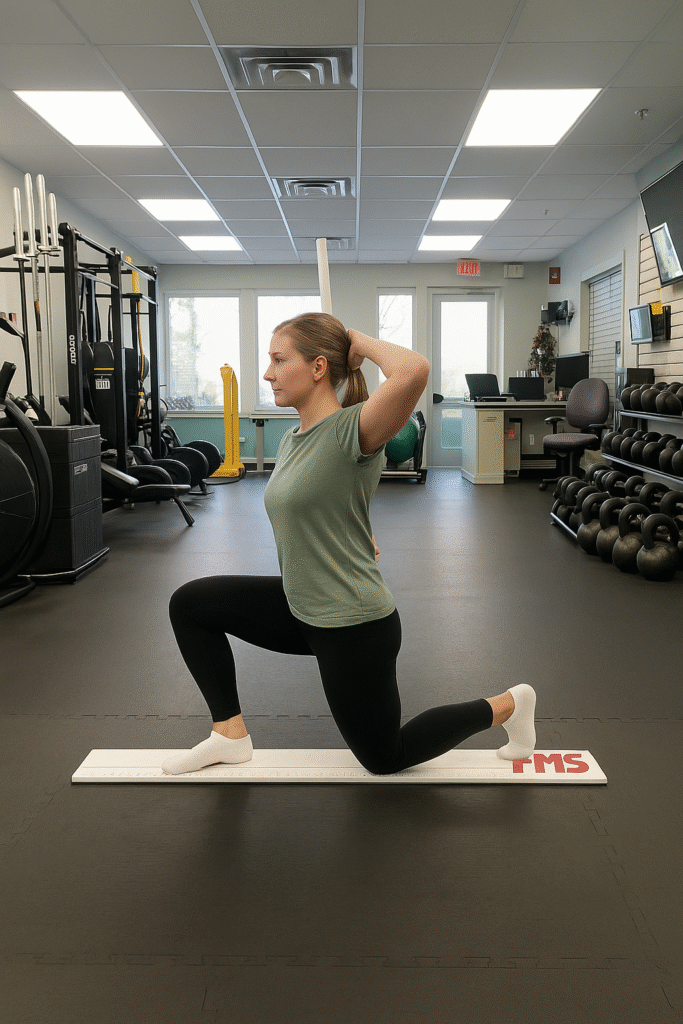
Inline lunge pattern assessment used at Passion for Fitness to identify loading readiness.
Muscle Balance & Smart Loading — Before You Add Weight
Functional strength training starts with balance, control, and quality movement—not heavy loading. When your joints aren’t aligned, your hips tighten, your spine compensates, and every rep multiplies the imbalance. Before you increase load, your body must pass one test: Can you control the pattern with your own bodyweight?
This is where most injuries begin—not with the weight itself, but with the movement underneath it.
Why Functional Strength Training Starts With Balance
Every exercise you perform is a pattern. Squats, hinges, lunges, carries, presses—they all depend on your ability to stay centered, stable, and aligned. If one side of your body does more work than the other, the imbalance shows up as:
- Hip tightness
- Lower-back tension
- Knee discomfort
- Shoulder compensation
- Difficulty progressing in strength
These aren’t random issues—they’re predictable signs that the body is loading unevenly.
Learn how we correct movement patterns at Passion For Fitness.
The Problem: Adding Load to Dysfunction
Too many people jump straight to heavier weights without asking a critical question:
“Is my body ready to load this movement?”
If not, the nervous system chooses shortcuts:
- Wobbling or shifting to one side
- Knees collapsing inward
- Over-gripping through the low back
- Rotating the pelvis during extension
- Holding your breath to force stability
When this happens, the weight becomes irrelevant. You are simply reinforcing the exact patterns that cause tightness and irritation later.
In functional strength training, we never load dysfunction—we correct it first.
How to Know When Your Body Is Ready to Load
Before progressing, check these four things:
1. You Can Control the Movement on Both Sides Equally
If the right side moves differently than the left, that’s your first clue the pattern needs attention.
2. Your Hips Stay Level and Stable
If they rotate, shift, or tilt, your glutes aren’t doing their job.
3. Your Spine Stays Quiet
No arching, no twisting, no “helping” you get through the rep.
4. Your Breathing Stays Steady
If you have to hold your breath to stay stable, the load is too heavy.
These checkpoints are simple—but they predict progress and prevent injury.
What Happens When You Correct the Pattern First
Strength training becomes effortless once the body learns the correct pattern. Clients often report:
- Less back tightness during lifts
- More power from the hips
- Stronger glute engagement
- Smoother squats and hinges
- Better balance in single-leg work
- Increased confidence under load
This is when loading becomes safe, smooth, and productive.
Functional strength training isn’t just about lifting—it’s about lifting with integrity.
Common Patterns We Correct at Passion For Fitness
1. Overactive Low Back
When the glutes don’t fire, the lumbar spine takes over.
2. Hip Shift in Squats or Deadlifts
A dominant side pulls you out of alignment.
3. Knee Collapse in Lunges
This is a stability issue, not a strength issue.
4. Limited Hip Mobility
Often caused by poor core control, not tight muscles.
5. Rotation Under Load
This is one of the biggest predictors of back irritation.
By correcting these patterns early, the body becomes strong in the way it was designed to move.
Our Approach: Restore → Strengthen → Load
Step 1: Restore Movement Quality
We assess how your body moves, not just how much it lifts.
Step 2: Build Functional Strength Training Foundations
You learn stability, alignment, and control.
Step 3: Increase Load Safely and Progressively
Once the pattern is stable, strength increases rapidly.
This method reduces risk, improves performance, and builds true longevity.
Outbound Sources
These support the concepts without making medical claims:
- American College of Sports Medicine – Movement Quality Principles
- National Strength & Conditioning Association – Corrective Strength & Stability
- StrongFirst – Tension, Stability, and Force Production
Your Body Is Stronger When It’s Balanced
If you think your progress is slow or you’re always feeling “tight,” the issue isn’t your strength—it’s your pattern. Fix the imbalance, and the strength follows naturally.
Functional strength training gives you the blueprint. We give you the coaching.