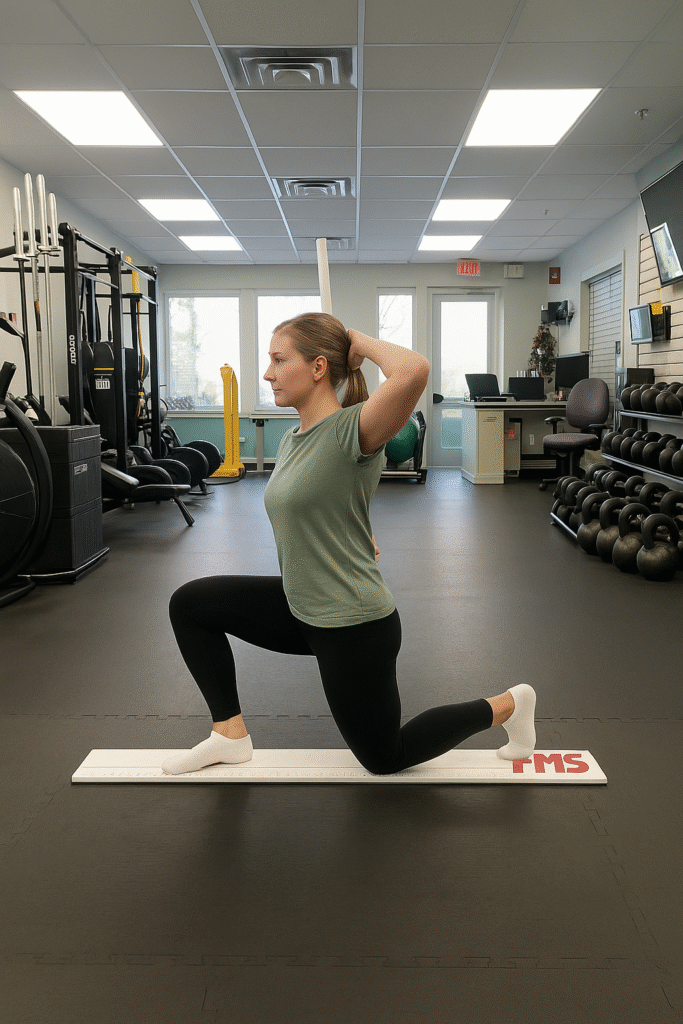
Inline lunge pattern assessment used at Passion for Fitness to identify loading readiness.
At Passion for Fitness, you can work with a personal trainer in Exton, and we also provide expert personal training in Downingtown for adults who want to move better, reduce tightness, and build real strength safely. We specialize in strength training in Exton for adults over 40 who want to eliminate tightness, restore balance, and train with confidence. Clients come to us from Exton, Eagleview Town Center, Downingtown, Lionville, Eagle, Phoenixville and across Chester County. The process always begins with one principle: restore balance before adding load.
Functional strength training begins with control, alignment, and precision—not heavy weights. When your movement patterns break down, your hips tighten, your spine compensates, and every rep multiplies the imbalance. Before you increase load, your body must pass one test: Can you control the pattern with your own bodyweight?
This is where most injuries start—not with the weight, but with the poor movement underneath it.
Why Functional Strength Training Starts With Balance
Whether you’re training at our Exton or Phoenixville studios—or working with a personal trainer in Exton—every exercise is a pattern. Squats, hinges, lunges, loaded carries, and presses depend on staying centered and aligned. When one side of the body takes over, you see the same predictable issues we correct every week here in Chester County:
- Hip tightness
- Lower-back tension
- Knee discomfort
- Shoulder compensation
- Difficulty progressing in strength
These aren’t random problems—they’re signs your body is loading unevenly.
This is why many clients seek out personal training in Downingtown or strength training in Exton—to correct these patterns before heavier loading.
Learn how we correct movement patterns at Passion For Fitness.
The Problem: Adding Load to Dysfunction
Many adults—especially those returning to fitness in Exton, Downingtown, and Lionville—jump straight to heavier weights without asking an essential question:
“Is my body ready to load this movement?”
If not, the nervous system takes shortcuts:
- Wobbling or shifting to one side
- Knees collapsing inward
- Over-gripping through the low back
- Rotating the pelvis during extension
- Holding your breath to stay stable
When these compensations appear, the weight doesn’t make you stronger—it reinforces dysfunction.
How to Know When Your Body Is Ready to Load
Before progressing your weights, check these four indicators:
1. You Can Control the Movement on Both Sides Equally
If your right and left sides move differently, the pattern isn’t ready for load.
2. Your Hips Stay Level and Stable
If they rotate, shift, or tilt, your glutes aren’t providing the stability you need.
3. Your Spine Stays Quiet
No arching, twisting, or “helping” you get through the rep.
4. Your Breathing Stays Steady
If you must hold your breath, the weight is too heavy for your current pattern control.
These checkpoints predict progress and dramatically reduce injury risk.
What Happens When You Correct the Pattern First
Once alignment is restored, strength training becomes easier—and safer. Clients from Eagleview Town Center, Eagle, and all over Chester County often report:
- Less back tightness during lifts
- More power from the hips
- Stronger glute activation
- Smoother squats and hinges
- Better balance during single-leg work
- Greater confidence under load
When the body moves the way it was designed to move, loading becomes both safe and productive.
Common Patterns We Correct at Passion For Fitness
We routinely assess and correct these patterns in adults over 40 training in Exton, Downingtown, Lionville, and surrounding Chester County communities:
1. Overactive Low Back
Occurs when the glutes fail to engage properly.
2. Hip Shift in Squats or Deadlifts
One side dominates and pulls the pelvis out of alignment.
3. Knee Collapse in Lunges
A stability problem—not a strength problem.
4. Limited Hip Mobility
Usually caused by poor core control rather than muscle tightness.
5. Rotation Under Load
One of the biggest predictors of back irritation and training plateaus.
Correct these early, and the body becomes strong, stable, and resilient.
Our 3-Phase Approach: Restore → Strengthen → Load
Phase 1: Restore Movement Quality
This is the foundation. Before adding weight, we assess how your hips, spine, and core work together. We correct imbalances, improve stability, and teach the patterns your body must master before loading. Most adults in our strength training in Exton programs uncover small but important weaknesses during this phase.
Phase 2: Strengthen the Pattern
After the pattern is restored, we begin building true functional strength. This phase focuses on glute activation, core control, alignment, and balanced tension.
Phase 3: Load Safely & Progressively
Once the movement is sound, we add load. Weight begins to feel easier, more controlled, and more powerful. This is where clients in Exton, Downingtown, and Chester County see dramatic improvements in performance and confidence—without joint pain or setbacks.
Outbound Sources
- American College of Sports Medicine – Movement Quality Principles
- National Strength & Conditioning Association – Corrective Strength & Stability
- StrongFirst – Tension, Stability, and Force Production
Your Body Is Stronger When It’s Balanced
If you’re looking for safe, effective personal training in Downingtown that corrects imbalances and builds long-term strength, our Restore → Strengthen → Load method is designed for you.